
Multiple Sclerosis Symptoms and Diet: What Nutrition Can and Cannot Improve
If you're living with multiple sclerosis, it's important to be clear about what nutrition can realistically do — and what it can't.
The key distinction is this: primary vs. secondary symptoms.
Some MS symptoms result from structural damage to the nervous system. Others are influenced by factors such as inflammation, metabolism, sleep, and overall health. Knowing this difference helps you put your energy where it can actually make a difference — and stop blaming yourself when diet doesn't fix something it was never capable of fixing.
This is the framework I come back to more than almost any other in my work, because once you understand it, you stop asking "can food cure my MS?" and start asking a much more useful question: "which of my symptoms might have secondary contributors I can actually do something about?"
That second question has real answers.
Quick Takeaways
Primary MS symptoms result from structural nerve damage — diet cannot reverse demyelination or repair axons.
Secondary symptoms are influenced by modifiable factors like inflammation, sleep, metabolic health, and eating patterns — this is where nutrition has real, evidence-based impact.
Many MS symptoms (especially fatigue) have both primary and secondary components, which is why diet helps some people feel meaningfully better even though it doesn't change the disease itself.
Clinical trials consistently show that dietary interventions improve fatigue, mood, and metabolic health — but do not change disability scores.
That's not a failure of nutrition. It's a reflection of what diet is designed to influence.
Table of Contents
Multiple Sclerosis Symptoms and Diet: What Nutrition Can and Cannot Improve
Understanding Primary MS Symptoms
Understanding Secondary MS Symptoms
Why the Overlap Matters — Especially for Fatigue
Where Nutrition Makes a Real Difference
Metabolic Health and Body Composition
The Consistent Pattern in Clinical Trials
How to Use This Framework in Your Own Life
Step 1: Identify the secondary contributors to your worst symptoms
Step 2: Address the modifiable factors, starting with the easiest wins
Step 3: Don't expect diet to do what DMTs do
Step 4: Track symptom-focused outcomes, not disease outcomes
Understanding Primary MS Symptoms
Primary symptoms result from immune-mediated damage to the brain and spinal cord — including demyelination and axonal injury. These are the symptoms that come from the disease, doing what the disease does to nerve tissue.
Examples include vision problems (optic neuritis), spasticity and muscle stiffness, sensory changes (numbness, tingling, pain, itching, dysesthesia), weakness and gait impairment, balance and coordination problems, bladder, bowel, and sexual dysfunction, cognitive changes, mood changes (including depression), fatigue, speech difficulties, and vertigo or dizziness.
These symptoms reflect structural disruption of nerve signaling. Because they arise from injury to myelin and axons, they are not reversed by diet. No food repairs a severed nerve fiber. No eating pattern rebuilds lost myelin. That's the hard truth, and it's worth stating clearly — because a lot of the internet will tell you otherwise.
Understanding Secondary MS Symptoms
Secondary symptoms arise from complications of that primary damage, or from factors that worsen underlying symptoms. These symptoms are real and often just as disruptive as the primary ones. But their contributing factors are frequently modifiable.
Examples include worsening fatigue, recurrent UTIs related to bladder dysfunction, falls due to weakness or imbalance, pressure injuries from immobility, and anxiety or depression intensified by life stress.
Common contributing factors include deconditioning and inactivity, poor sleep, medication side effects, infection or other illness, stress, dehydration, metabolic dysfunction, and eating patterns.
Unlike primary symptoms, the contributing factors influencing secondary symptoms are often things you can actually do something about. That distinction matters — and is almost never part of the conversation when someone online tells you to "eat to fight MS."
Food choices and habit modifications can meaningfully impact your health and secondary MS symptoms. But they cannot entirely offset the effects of demyelination. Both things can be true at the same time.
Why the Overlap Matters — Especially for Fatigue
Here's where it gets more nuanced — and more useful.
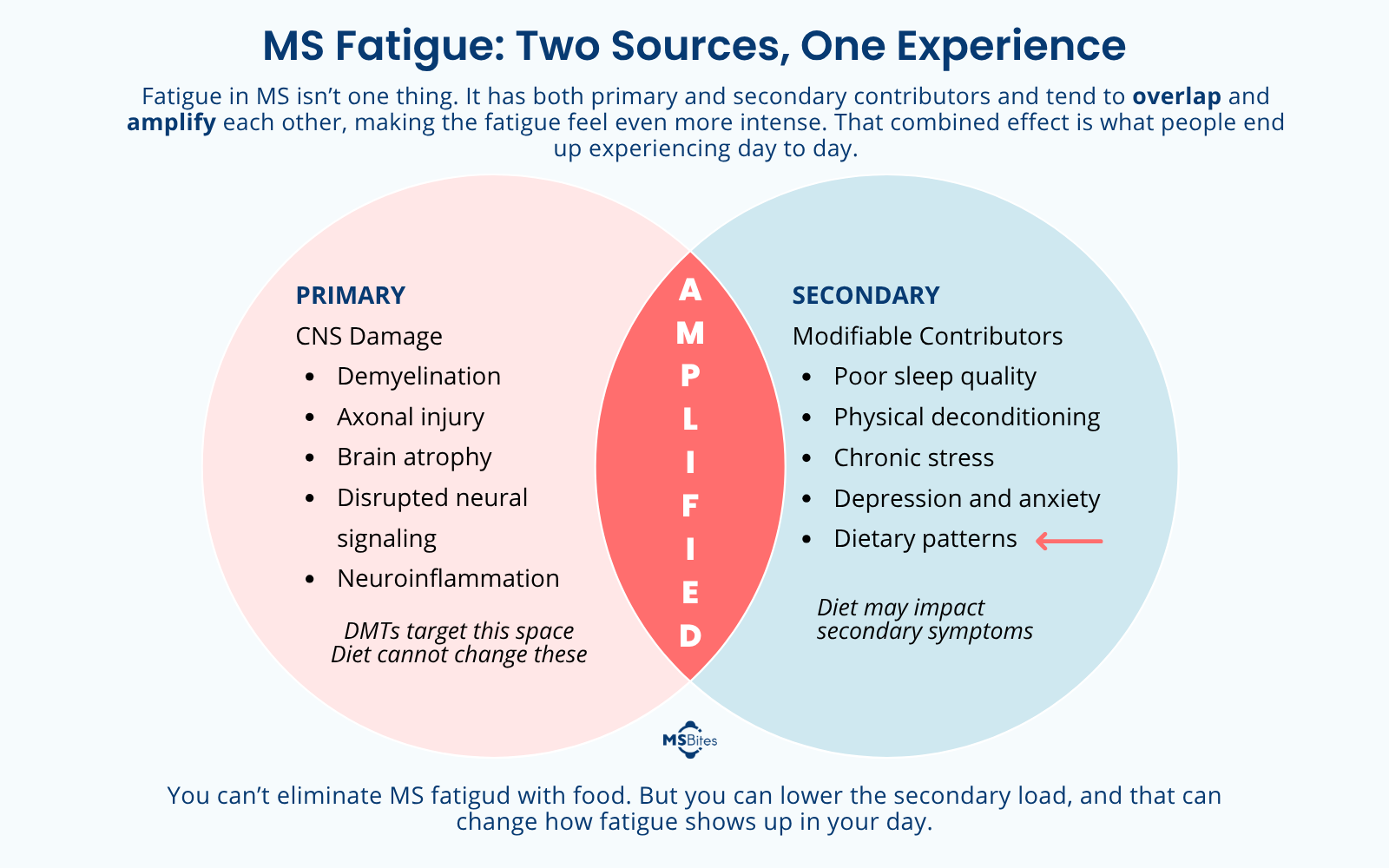
Many common MS symptoms have elements of both primary and secondary causes. A single symptom may originate from direct nervous system damage (primary) and be intensified by modifiable factors (secondary).
Fatigue is the clearest example. It can arise directly from CNS damage — that's the primary component. But it can also worsen due to poor sleep, medication side effects, deconditioning, infection, depression, stress, dehydration, or metabolic changes — those are secondary contributors.
This overlapping pattern also applies to cognitive difficulties, mood symptoms, bladder and bowel function, and mobility limitations. In each case, both structural damage and modifiable lifestyle factors play a role.
Why does this matter? Because a symptom may originate from structural damage and then be amplified by modifiable factors. You can't fix the origin. But you can often turn down the volume on the amplifiers.
Fatigue is one of the most responsive MS symptoms to modifiable factors, which is exactly why clinical trials consistently show dietary interventions helping with fatigue even when they don't change disability scores. The diet isn't repairing nerve damage. It's addressing the secondary contributors that were making the fatigue worse than it needed to be.
That's an important distinction. And for the person who's been told that diet should "fix" their MS and is wondering why it hasn't — this is the answer.
What Nutrition Cannot Do
Let me be direct here, because setting the limits first makes everything that follows more trustworthy.
It cannot reverse established nerve damage. When myelin is lost, or axons are damaged, that's structural injury. There is no high-quality clinical evidence that any diet regenerates myelin, repairs axons, or alters structural disease progression. Anyone claiming otherwise is ahead of the evidence.
It cannot replace disease-modifying therapies. DMTs are designed to reduce the inflammatory immune activity that drives MS progression. Diet does not perform that function. Diet can complement DMT. It does not replace it.
It does not consistently change disability scores. This is one of the most important — and often misunderstood — findings in MS nutrition research. A 2022 meta-analysis of eight randomized controlled trials (515 participants) found trends toward reduced fatigue and improved quality of life, but no significant effect on EDSS disability scores (Guerrero Aznar et al., 2022).
People often feel better even when EDSS scores do not change.
That isn't a failure of nutrition. It reflects what diet is — and isn't — designed to influence. Diet operates on the secondary contributors: systemic inflammation, metabolism, energy regulation, and mood. The EDSS measures the structural consequences of nerve damage. Different targets, different tools.
Where Nutrition Makes a Real Difference
If you stop at the limitations, it sounds discouraging. So don't stop there.
MS affects more than lesions on an MRI. It affects energy, mood, thinking, mobility, sleep, metabolism, and overall resilience. And many of those day-to-day experiences are shaped by systemic inflammation and metabolic health — areas where nutrition has measurable influence.
Fatigue
Fatigue is one of the most common — and most disruptive — symptoms in MS. It's also one of the areas where diet appears to help the most.
Multiple clinical trials and systematic reviews report improvements in fatigue following dietary interventions (Guerrero Aznar et al., 2022; Snetselaar et al., 2023). In one 12-month pilot study of a diet-based lifestyle program for people with progressive MS, participants experienced substantial reductions in fatigue, and improvements in cholesterol and other lipid markers were associated with those fatigue changes (Fellows Maxwell et al., 2019).
That pattern shows up repeatedly: people may not see measurable shifts in EDSS scores, but they often report having more usable energy. For someone living with MS, the difference between "I could not get through the afternoon" and "I managed the afternoon" is not trivial. That's the difference between being able to work, cook dinner, or play with your kids — and not.
Mood: Depression and Anxiety
Systemic inflammation, blood sugar stability, gut health, and metabolic function all influence mental health. Diet plays a role in each of these.
A 2024 study found that a more pro-inflammatory diet was associated with higher long-term depression and anxiety levels in people with MS (Saul et al., 2024). Conversely, anti-inflammatory dietary patterns have been linked to improvements in mood and mental quality of life.
Diet is not a substitute for mental health care. But it can support emotional resilience — and for someone managing a disease that already puts enormous pressure on mental health, that support is worth protecting.
Metabolic Health and Body Composition
MS doesn't occur in isolation. Many people with MS also live with insulin resistance, elevated cardiovascular risk, or other metabolic challenges. These aren't just parallel problems — they actively worsen MS outcomes.
Clinical trials show that structured dietary interventions can improve mobility, cardiometabolic markers, body composition, and quality of life (Bruce et al., 2023; Papandreou et al., 2022). A randomized controlled behavioral intervention in adults with MS and obesity found significant improvements in mobility and daily functioning. A personalized Mediterranean diet intervention improved body composition and cardiometabolic health in women with MS.
This isn't about body size. It's about reducing metabolic burden on a system already managing a chronic disease.
Cognitive Function
Many people with MS describe "brain fog" — slower processing, memory lapses, difficulty concentrating. As someone who lives with MS-related cognitive challenges, I can tell you the experience is as frustrating as it is invisible.
Some studies suggest dietary interventions — especially when combined with exercise and stress management — may improve perceived cognitive function. A 2024 study of a remote multimodal program (diet, walking, breathing exercises) in newly diagnosed individuals showed improvements in perceived cognitive function, fatigue, and mental quality of life (Saxby et al., 2024).
The strongest effects tend to occur when diet is part of a broader set of daily practices — not when it's expected to do all the heavy lifting alone.
Bladder and Bowel Function
Nobody's favorite topic, but it matters. Mediterranean-style eating patterns have been associated with improvements in bladder and bowel function in people with MS. Fiber intake, gut microbiome composition, and hydration all play important roles here, though research is still developing.
And while we're on the subject: several popular MS diets eliminate the very foods that are the richest sources of fiber, while simultaneously promoting gut health. That math doesn't add up.
Curious about diet and MS?— see What Is the Best Diet for Multiple Sclerosis? An Evidence-Based Guide.
The Consistent Pattern in Clinical Trials
Across dietary approaches and study designs, a clear pattern emerges in MS nutrition research:
Fatigue and quality of life often improve. Whether the dietary intervention is Mediterranean-style, modified anti-inflammatory, plant-based, ketogenic, or part of a broader lifestyle program, people frequently report less fatigue and better quality of life (Guerrero Aznar et al., 2022; Harirchian et al., 2022).
Metabolic markers improve. Cholesterol, blood sugar, body composition, and inflammatory markers — these respond to dietary change in people with MS just as they do in the general population.
Multimodal programs show stronger effects. Some of the most promising results come from programs combining diet with exercise, stress reduction, and behavioral support. A diet-based multimodal program in progressive MS showed large reductions in fatigue over 12 months (Fellows Maxwell et al., 2019). A remote lifestyle program in newly diagnosed individuals improved fatigue, mental quality of life, and perceived cognitive function (Saxby et al., 2024). Consistently, the combination outperforms diet alone.
Disability scores typically do not change. In the 2022 meta-analysis and across the broader literature, dietary interventions did not significantly alter EDSS disability scores (Guerrero Aznar et al., 2022). Diet influences symptoms and systemic health. It does not reverse structural nerve damage.
This is not a contradiction. It's the primary/secondary framework in action. Diet addresses the modifiable contributors. The EDSS measures the structural consequences. They're measuring different things.
For many people living with MS, improving how you feel day to day — having more usable energy, fewer mood swings, better digestion, improved stamina, greater consistency — is not a consolation prize. It's the thing that makes the difference between managing and not managing. Between living and just enduring.
How to Use This Framework in Your Own Life
The primary/secondary distinction isn't just academic. It's a practical tool. Here's how to apply it.
Step 1: Identify the secondary contributors to your worst symptoms
Pick your most disruptive symptom — for many people, that's fatigue. Now ask: what's amplifying it?
Are you sleeping poorly? Are you dehydrated? Is your blood sugar swinging because you're skipping meals or eating erratically? Are you deconditioned from inactivity? Is a medication contributing? Is depression or anxiety in the picture? Is your eating pattern heavily processed and nutrient-poor?
You can't always sort out exactly how much is primary and how much is secondary. But you can identify modifiable factors and start addressing them — even without knowing the precise ratio.
Step 2: Address the modifiable factors, starting with the easiest wins
You don't need to overhaul everything at once. Start with the lowest-hanging fruit:
Hydration — dehydration worsens fatigue, cognitive function, and bladder issues. Free. Immediate. Start here.
Meal consistency — eating at roughly regular intervals with adequate protein stabilizes blood sugar and energy. If you're skipping meals or going long stretches without eating, that's amplifying your fatigue.
Nutrient density — more vegetables, fruits, whole grains, fish, nuts, legumes. Not perfection. Direction. Add before you eliminate. antiinflammatory article
Sleep — if you're not sleeping well, everything else gets harder. This may need medical attention, not just dietary change.
Movement — even modest, consistent physical activity reduces fatigue, improves mood, and supports metabolic health. Diet and movement together consistently outperform either alone.
Step 3: Don't expect diet to do what DMTs do
This is worth repeating. Diet addresses secondary contributors. DMTs target the disease process. They're complementary, not competing. If you're delaying or avoiding DMTs because you're hoping diet will be enough, please talk to your neurologist.
Step 4: Track symptom-focused outcomes, not disease outcomes
Instead of asking "is my diet stopping my MS?" — which it isn't designed to do — track the things diet actually influences:
Energy levels across the day
Mood stability
Cognitive clarity
Sleep quality
Digestive comfort
Daily function and stamina
These are the outcomes where dietary change shows the most consistent benefit. And they're the outcomes that determine how you actually feel living with this disease.
Step 5: Work with your healthcare team
Dietary changes should support, not replace, medical care. If nutrition is affecting your health — or if you're not sure whether it is — ask for a referral to a registered dietitian with experience in MS or chronic disease management. A dietitian can assess your actual intake, identify gaps, and help you build an approach that fits your real life.
If you're newly diagnosed and not sure where to start — see Newly Diagnosed with MS? What You Actually Need to Know About Diet.

Frequently Asked Questions
Can diet reverse MS nerve damage?
No. Primary MS symptoms result from structural damage to myelin and axons. No diet has been shown to regenerate myelin or repair nerve fibers. Diet influences secondary contributors to symptom burden — not the underlying structural disease.
Why do I feel better when I eat well if diet can't change MS?
Because many MS symptoms have secondary contributors — inflammation, metabolic health, blood sugar regulation, sleep quality, gut health — that are responsive to dietary change. You're not reversing the disease. You're turning down the volume on the factors that were amplifying your symptoms.
If diet improves fatigue but not disability scores, is it actually helping?
Yes. Fatigue is one of the most disabling symptoms in MS, and it profoundly affects quality of life, employment, relationships, and daily function. The fact that dietary interventions consistently improve how people feel — even when EDSS scores don't change — reflects that diet is addressing the modifiable contributors to symptom burden. That's what it's designed to do.
Which MS symptoms are most responsive to dietary change?
Based on current evidence, fatigue, mood (depression and anxiety), metabolic health, and quality of life show the most consistent improvement with dietary interventions (Guerrero Aznar et al., 2022). Bladder and bowel function also appear to respond to dietary quality, though the evidence is still developing.
Should I focus on a specific MS diet or just eat healthy?
A generally healthy eating pattern — particularly Mediterranean-style eating — has the strongest and most consistent evidence for MS symptom support. You don't need a branded MS protocol. You need consistent, nutrient-dense eating that fits your life.
Does exercise make dietary changes more effective?
Yes. Multimodal programs that combine diet with exercise, stress reduction, and behavioral support consistently show stronger effects than diet alone (Saxby et al., 2024; Fellows Maxwell et al., 2019). Diet and movement are better together.
Can diet help with MS cognitive fog?
Possibly. Some studies show improvements in perceived cognitive function with dietary and lifestyle interventions, particularly when combined with exercise (Saxby et al., 2024). The evidence is earlier-stage than for fatigue, but encouraging.
Where This Leaves You
Understanding the difference between primary and secondary MS symptoms changes the entire conversation about diet.
Diet does not reverse demyelination. It does not repair damaged axons. It does not replace disease-modifying therapies. And it does not consistently change disability scores.
But it does reduce fatigue in many people. It does improve mood and quality of life. It supports metabolic and cardiovascular health. And it improves day-to-day function in ways that clinical scales don't always capture but that you absolutely feel.
MS is a disease of the nervous system. Diet is a lever on systemic health. You cannot directly control immune attacks on your central nervous system. But you can influence inflammation, blood sugar regulation, metabolic function, and many of the secondary factors that shape how your symptoms actually show up in your life.
In a condition where much feels outside your control, that sphere of influence is real — and it's yours.
References
Bruce, J. M., Cozart, J. S., Shook, R. P., et al. (2023). Modifying diet and exercise in multiple sclerosis (MoDEMS): A randomized controlled trial for behavioral weight loss in adults with multiple sclerosis and obesity. Multiple Sclerosis Journal, 29(14), 1860–1871. https://doi.org/10.1177/13524585231213241
Fellows Maxwell, K., Wahls, T., Browne, R. W., et al. (2019). Lipid profile is associated with decreased fatigue in individuals with progressive multiple sclerosis following a diet-based intervention: Results from a pilot study. PLOS ONE, 14(6), e0218075. https://doi.org/10.1371/journal.pone.0218075
Guerrero Aznar, M. D., Villanueva Guerrero, M. D., Cordero Ramos, J., et al. (2022). Efficacy of diet on fatigue, quality of life and disability status in multiple sclerosis patients: Rapid review and meta-analysis of randomized controlled trials. BMC Neurology, 22(1), 388. https://doi.org/10.1186/s12883-022-02913-w
Harirchian, M. H., Karimi, E., & Bitarafan, S. (2022). Diet and disease-related outcomes in multiple sclerosis: A systematic review of clinical trials. Current Journal of Neurology, 21(1), 62–70. https://doi.org/10.18502/cjn.v21i1.9362
Papandreou, P., Gioxari, A., Daskalou, E., Vasilopoulou, A., & Skouroliakou, M. (2022). Personalized nutritional intervention to improve Mediterranean diet adherence in female patients with multiple sclerosis: A randomized controlled study. Dietetics, 1(1), 25–38. https://doi.org/10.3390/dietetics1010004
Saul, A. M., Taylor, B. V., Blizzard, L., et al. (2024). A pro-inflammatory diet is associated with long-term depression and anxiety levels but not fatigue in people with multiple sclerosis. Multiple Sclerosis and Related Disorders, 84, 105468. https://doi.org/10.1016/j.msard.2024.105468
Saxby, S., Shemirani, F., Crippes, L., et al. (2024). Effects of a remote multimodal intervention involving diet, walking program, and breathing exercise on quality of life among newly diagnosed people with multiple sclerosis: A quasi-experimental non-inferiority pilot study. Degenerative Neurological and Neuromuscular Disease, 14, 1–14. https://doi.org/10.2147/DNND.S441738
Snetselaar, L. G., Cheek, J. J., Fox, S. S., et al. (2023). Efficacy of diet on fatigue and quality of life in multiple sclerosis: A systematic review and network meta-analysis of randomized trials. Neurology, 100(4), e357–e366. https://doi.org/10.1212/WNL.0000000000201371
This article is for informational purposes and is not a substitute for individualized medical or nutrition advice. If you're considering dietary changes, talk to your healthcare team. And if that team doesn't include a registered dietitian, ask for a referral. Especially if you're trying to sort out which of your symptoms might respond to what you're eating. That's literally what we do.